
Mapping Our School
A team maps the school sports field from above and debates where a new park should go.
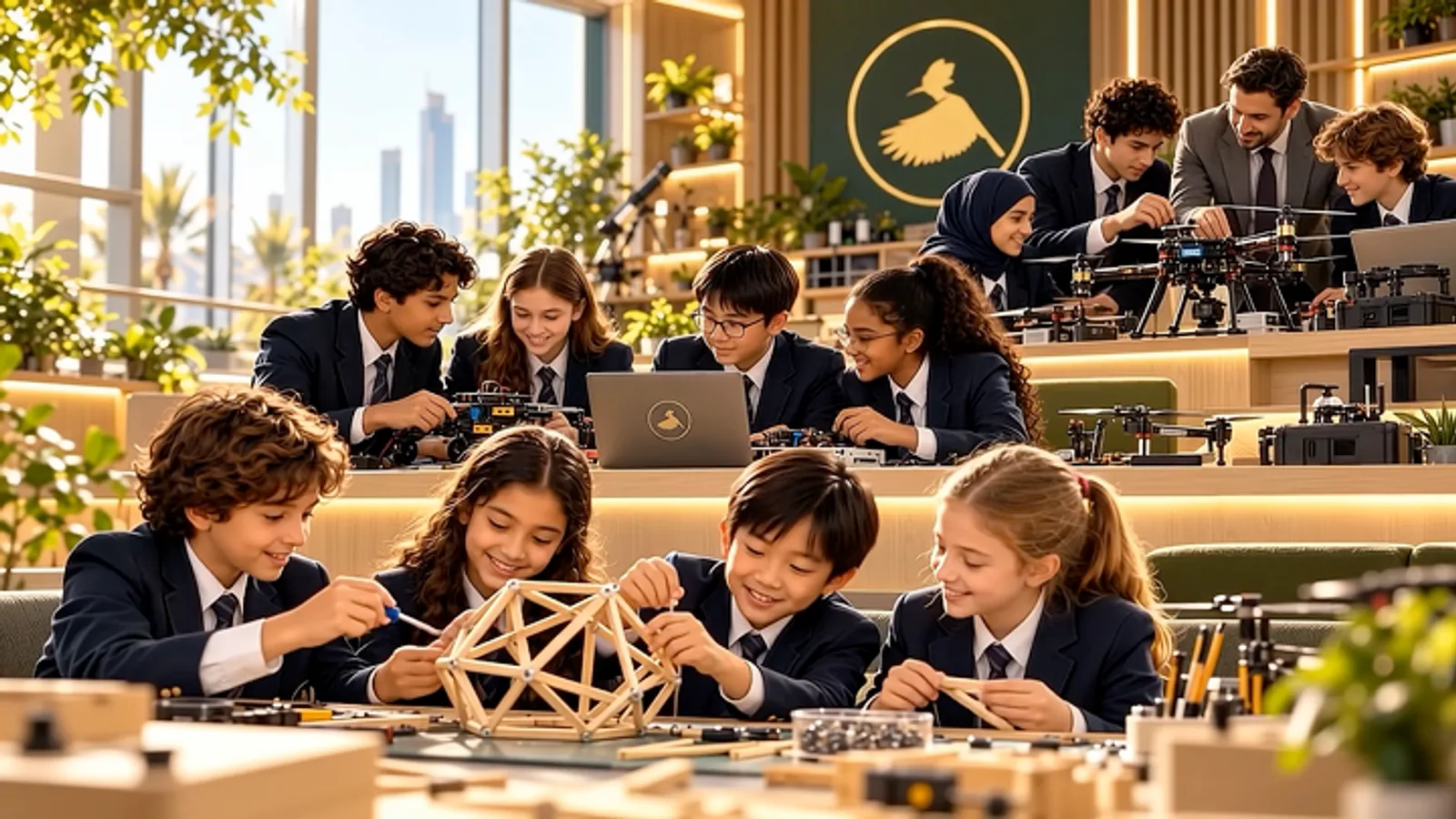
Learners begin with senses, sensors and the sky. As their understanding grows, they investigate Artificial Intelligence (AI), data and code, test designs, and explain increasingly ambitious projects.
These three illustrative examples show how Fanoos and Saqqar develop together through primary, middle and secondary learning.
Before these projects, children explore artificial or natural things, senses and sensors. Saqqar introduces the sky through story and play.
A team maps the school sports field from above and debates where a new park should go.
Senses, sensors and the idea that people teach intelligent systems with data.
Sky safety, route coding, simulation and a supervised first hover.
At a desert solar field, learners use drone thermal imaging to find three underperforming panels.
Labelled data, machine learning, bias and an ethical case for a decision.
Simulator discipline, Python flight scripts, a 3D-printed airframe part and supervised FPV flight.
Their drone maps and treats a reclaimed desert plot row by row, then the team defends its data to an expert panel.
Advanced machine learning, neural networks, generative AI and designing fairer systems.
Avionics, flight programming, risk assessment and a Build, Fly and Defend capstone.
These projects illustrate curriculum progression. They do not describe an individual pupil.
At each stage, pupils make or investigate something, then explain the choices behind it. The work grows from early designs to tested AI ideas and engineering projects.
Both curricula are supported across British and American curriculum settings. In American curriculum settings, Fanoos covers KG–Grade 12; ask us which curriculum and year groups fit your school.
Discuss the year groups and curriculum version your school needs.